


I thought they’d balk at the suggestion of extra work. Maybe refuse to do it. At minimum, I expected a litany of under-the-breath complaints.
“Why do we have to do this, and the other classes don’t?”
“Are you grading it?”
“If you aren’t grading it, what do we get for it?”
Worse case, I expected mutiny.
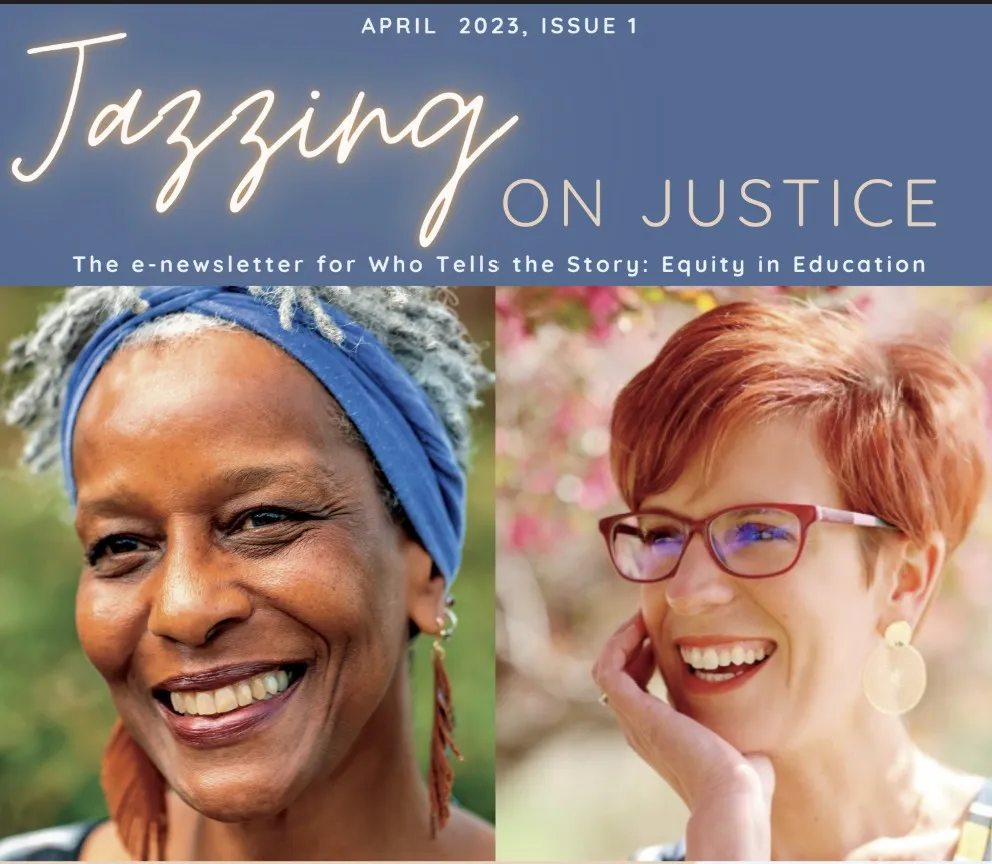
At that point, Norma Johnson, a Black poetic storyteller and racial justice catalyst, and I, a White, 6th grade language arts and reading teacher, had been working together to create and grow a joint venture titled Who Tells the Story for about three years.
Norma and I were first introduced through a mutual friend when I hit a frustration point in my instruction. I teach at Southern Hills, a predominantly White, upper-middle class school in Boulder, Colorado. Although I’d been teaching about race and racism through novels and nonfiction texts for years, I felt a gap in my classroom–a place that I, as a White person, could never quite touch.
As much as we talked about race, most White students still viewed it as somebody else’s problem, as isolated incidents of bullying, aggression, and violence–not as systemic and foundational to their histories, communities, and lives. The White students also struggled to see themselves as…well…White. And in these discussions, the few students of color, whether they were vocal or silent, bore the weight of the conversation as it landed squarely on their identity.
Wanting to work more deeply with these questions, I took an anti-racist training in the spring of 2021 with other teachers at my school. The training was facilitated by the YWCA Boulder County. After one of our sessions, I was chatting casually with Debbie Pope, the CEO of the YWCA and a co-facilitator of the training. She’s a White woman and the mother of two multi-racial teens, one of whom I’d had in class a few years prior, and the other I would have the following school year. Debbie told me about Norma and suggested we meet; maybe she could visit my class and share one of her poems as a different entry point to conversations about race.
Norma and I connected immediately, the kind of deep and instant connection that happens so rarely we can count the folks we’ve bonded with in this way on one hand.
It was clear one isolated visit wasn’t going to be enough.
I organize my classroom around thread words–courage, humanity, identity, empathy, connection, story, and journey. Norma and I decided to see if we could raise the money for her to visit my classroom once during each or most of the words. Norma would share a poem related to our current word, and then the two of us would work together to help students connect their reading, writing, and lives to the poem. The YWCA and Southern Hills stepped in to support our work the following school year, and Norma has been visiting my classroom around four or five times a year ever since.
Norma’s visits were always powerful. Students moved through joy, laughter, stunned silence, disbelief, and grief. They wrote her heartfelt thank you letters, and we discussed her poetry in class long after her visits ended.
Yet, even as we knew our work was changing the lives of the students, we felt a pull to do even more. And as our partnership grew, so did interest from district folks, families, and community organizations. We realized we needed to be able to explain what we were doing to others in a succinct and tangible way.
Ultimately, the inquiries of others forced us to ask the question…what were we really doing?
We knew our work together clearly incorporated language arts and reading skills. We knew it centered on diversity, equity, and inclusion. We knew it held at its core the hope to help students grow into heart-centered humans, ready to help their communities and world move toward healing. And we knew there was another element, as well–something about the power of partnership, of community, of building bridges and making connections.
With those hopes in mind, we crafted our mission statement: Who Tells the Story aims to provide middle students with opportunities to explore and establish relationships across differences as a direct route to social change.
Through Norma’s visits, she and I were able to model making connections across a variety of differences. We’re about 25 years apart in age. She grew up in New Jersey; I grew up in Colorado. And the most notable difference: Norma is Black, and I’m White.
As I mentioned, the student body at Southern Hills is mostly White. Students are often high-achieving and come from academically minded families. While many of the White students arrive with a lean towards social justice, their passions can be more theoretical than experiential. They’ve read novels by and about people of color, but their friend groups and those of their parents are predominantly White. They’ve visited places all over the world, but they don’t spend much or any time in Boulder’s Latino community. And they often conceptualize racism as a historical and contemporary problem perpetuated and experienced by other people in far away places or in the past.
For most of these students, witnessing a White woman and Black Woman co-teaching in their classroom is virtually unheard of. So just us standing together, before we even speak, demonstrates for so many students how connection across differences can function–what it could really mean. Then, when we laugh together, play off each other, question each other, compliment each other, and show our deep affection, kids bear witness to a relationship many have rarely, if ever, seen.
We believe this type of modeling stands out in its power to affect and change kids’ ways of thinking about and being in the world. And yet we also wanted to provide students with the opportunity to establish their own connections across differences with people their own age.
Working to establish this connection amidst the constraints of a school schedule is easier said than done. We worked a variety of angles, and our collective energy often took us in fantastic directions. At one point, we even considered an exchange program with youth living on the Northern Arapaho Reservation in Wyoming. We imagined bussing Southern Hills students to the reservation and bringing Arapaho teens to Boulder. We pictured a gathering including families and food and connection.
As transformative as that would be, we eventually landed on an option closer to home and easier to implement.
We decided to connect Southern Hills students with students at Ricardo Flores Magón Academy (RFMA), a K-8 charter school in Denver with a predominantly Latino population. Norma already had a close connection with the school’s Dean of Culture, Marc Lytle.
Marc learned more about Who Tells the Story after attending one of our Equity in Education events in the fall of 2022. (Our Equity in Education work aims to inspire learning and connecting opportunities for educators.) Norma reached out to see if we might be able to connect our schools in some way, and in the fall of 2023, we aimed to link one of my classes with a class at Ricardo Flores Magón.
Although we initially hoped to connect one of my 6th grade classes with 6th graders at RFMA, we ultimately landed on a connection with a 4th grade class. Marc, Norma, Lorena Leal (the 4th grade teacher), and I met over Zoom to iron out the details. Again, our dreams were grandiose at first–maybe we could each film our respective schools. Perhaps we could bus RFMA students to Boulder and go for a hike together.
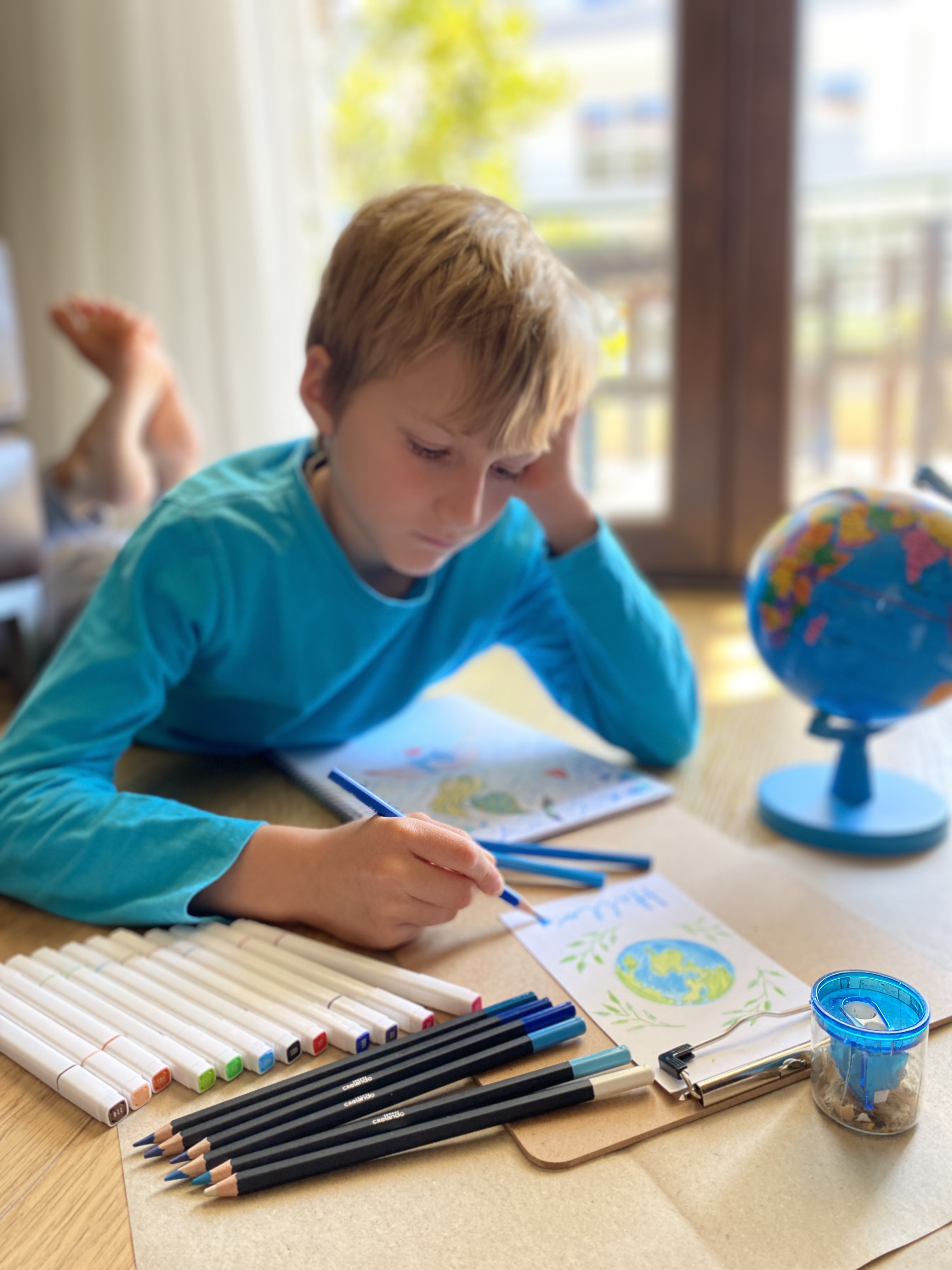
As the school year progressed and the strain of full-time teaching weighed on us, we decided to keep our first-year efforts small. We’d have kids write old-school, penpal-type letters back and forth. As simple as this seemed, even this low-tech option brought with it a few details to sort out.
Lorena wondered, “Some of my 4th graders have handwriting that’s pretty tough to read. Should I have them type their letters?”
I pondered this question. We could have the students type their letters and gather them all into one document, but I felt like something might be lost in that process, something about the power of sending your own written words to a friend, something about the magic of creating by hand.
“I kind of like the low-tech option,” I responded. “I’m sure I can use my teacher-powers to help them read the letters. And, some of my 6th graders have pretty bad handwriting, too. Maybe it will help them cultivate some empathy for me,” I joked.
“Also, I have a few students who only read and write in Spanish. Should I translate for them?” Lorena asked.
“I have quite a few students who could probably read and write enough in Spanish to craft a letter. And maybe that will foster empathy, too. My students will experience how hard it is to show your true self while learning a new language.”
At the end of our call, Lorena revealed that she had a penpal in elementary school.
“She lives in Washington. We still write letters to each other,” she smiled. “She’s coming to my wedding.” If I had any doubts about the simple, low-tech, and low-brow nature of our connection, Lorena’s revelation quelled them. Seeing her light up at the memory of sending and receiving letters, and hearing that she remained in contact with her penpal, convinced me this was a perfect first step.
Now I just had to bring the idea to my students.
Because Lorena taught 4th grade, she had only about 25 students total, whereas I had 80. We debated about how to make the numbers work and ultimately landed on a kind of pilot matchup–pairing her kiddos with one of my classes. I debated which group to choose. The numbers worked out perfectly if I chose my 4th-period class. But they were by far my rowdiest bunch. Would they take it seriously? Would they all turn in letters? Would they blow it off? Would they be irritated that they had to do extra work with no grade-based reward? Or, would they feel honored and perhaps improve their behavior?
I decided to give them the benefit of the doubt, and I hoped for the best.
Lorena sent me her class roster, and I paired my students with hers. I wrote brief directions and included a list of possible topics. I geared up to really sell the idea–to make them feel special. And I armored up for potential push-back.
“You know when Ms. Norma comes in?” I started, and they nodded. “One of our goals in working together is to model making connections across differences. For example, Ms. Norma is Black and I’m White. Ms. Norma is older than me. She grew up on the East Coast, and I grew up in Colorado. Well, one of our goals has also been to provide students with an opportunity to connect across differences. I know we do a lot of reading in this class about people with a variety of identities, but it’s different when you can actually bring diversity into your lives.”
Some continued nodding; some had taken to working their Rubix Cubes under the table; some started doodling or staring out the window. I took a deep breath. “Well, we’ve been working for a couple years on a way to make this happen for you all, and we finally figured out a plan!”
I paused for the big reveal. “And you all are an important part of it! This class, in particular, in fact!” Eyes popped up from Rubix Cubes. Doodling stopped. “Norma has a close connection with a school in Denver called Ricardo Flores Magón Academy. It’s a K-8, and the majority of the students are Latino. We are going to send penpal letters to the 4th grade class, and they are going to send letters back! And, guess what? You are the luckiest class because you are my only class that gets to do this!”
I braced for the backlash.
“Wait, we are the only class doing this?”
Oh no. Here we go.
“That’s right. Just this class.”
I waited for revolt.
“That’s so…cool!”
“Can we send pictures?”
“Will we get to meet them?”
Instead of complaints about extra work, I was met with joy and excitement. The kids didn’t feel burdened; they felt honored. I was elated.
“And there’s one other piece, “ I added with a big smile, playing off their excitement. “A few of the students only read and write in Spanish. Does anyone feel like they speak Spanish well enough to write a half-page letter about yourself? And it doesn’t have to be perfect! In fact, seeing you struggle with a second language might make your pen pal feel more connected to you.”
Hands shot up around the room. At least 10 students were willing to give it a try.
I gave each student the name of their pen pal and passed out the directions and list of topics.
“Can we work on this right now?”
“Well, yes, for a bit, but you might have to do some at home, too.”
Kids nodded and dug in right away. Quiet chatting filled the room.
“What’s your person’s name?”
“How do you say ‘summer’ in Spanish?”
“Can I use Google translate?”
Kids worked until the last possible minute, a few holding up their hands to ask for a bit more time.
“You can work on it more at home or if you have time in class later this week after your other work is done,” I reassured them. “I just need the final by next Tuesday.”
I carried their joy with me all afternoon..until 5th period, that is.
This bunch of students came in with snarls on their faces. I wondered what was going on. Had something happened at lunch? Were they upset about the reading?
“We heard 4th-period students get pen pals,” one student said.
“And we don’t,” another added.
“Why don’t we get them?”
“Why did you pick 4th period and not us?”
I stood still, unable to answer for a few seconds. Were these kids really upset because of work they didn’t get to do?
“I’m so sorry!” I said. “I could only pick one class. And…” I weighed if I should tell them the truth and decided to be honest. “I chose 4th period because the numbers matched up.” I hoped the reveal would soften the blow. A few kids laughed. Some still snarled.
“That’s not fair,” a few mumbled. I felt guilty…and secretly overjoyed! What I feared would be a tough sell was in fact the opposite. And the kids who weren’t included felt jilted rather than relieved.
After receiving all their letters (the only assignment of the year that every student turned in within a day of the due date), I wrote my own letter to Lorena and sent them off.
Nearly every day for the following two weeks 4th-period students asked about the letters. I reminded them they were traveling by snail mail, and once they were received, the kids had to read them, write their own, and mail them back. Finally the day came when the letters arrived.
I made the rookie mistake of dropping the big news at the beginning of class rather than the end. Once I announced, “Your letters are here!” my lesson plans were toast. The class was devoted to reading and sharing letters; showing off pictures, stickers, and other decorations; and deciphering Spanish.
“Can we write back right now?” they asked, many already getting to work without my direction.
As they worked, I read my note from Lorena. I’ve never had a pen pal, and I immediately understood their joy–holding someone else’s words; learning about someone I wouldn’t otherwise meet; feeling trusted to learn the ins and outs of someone’s daily routine, their dislikes and loves, their best hopes–felt so heart-warming.
As I watched them gush over their personal letters, I thought back to my work with Norma and our mission–to provide middle students with opportunities to explore opportunities and establish relationships across differences as a direct route to social change. I thought of our failed attempts to enact connection on a grand scale. I thought about how we’d ultimately landed on a relatively easy, low-tech option. I thought, too, about how, after over a decade of teaching, I’d so profoundly misjudged my students. I thought they’d need a reason–a grade or a bribe–to make a connection. But of course, the connection itself was the reward.
It’s doubtful, of course, that a few letters back and forth will dismantle White supremacy or eradicate racism. The students themselves might not even remember the assignment after a couple years go by. But, at the same time, how else can we begin to address a chasm of pain centuries old if not with simple yet heartfelt personal connection?
If not with the smallest steps toward closeness?
.jpg)
Educator
.webp)