



White kids hear it in the music they listen to. Maybe they hear their classmates of color use it amongst themselves. They see it scratched on bathroom walls. They read it in literature assigned in their language arts classes. But they know they can never ever ever ever say it. Or, they’re not supposed to anyway. The N-Word.
Most teachers and administrators working in predominantly White schools (at least in Boulder, and I can imagine throughout the state and the nation) have come face to face in recent years with the problem of White kids using the N-Word. Or White kids asking for the N-Word pass. Or White kids telling jokes that trick other kids into saying the N-Word. Or White kids claiming other White kids have used the N-Word.
As a 15-year-veteran teacher at Southern Hills, a predominantly White school in South Boulder, I’ve experienced all of the above semester after semester for at least the last seven years. And probably before that. I reference seven, though, because that was the year I had a Black student in class who was targeted by other students using the N-word.
The student reported the situation to the administrators, but their response was lackluster. It’s not that they didn’t want to help her; they just didn’t know what to do. They didn’t know how to provide safety and support for her while also educating the students who used the slur. At one point, the principal even asked the student what she thought he should do. The inability of the school to respond effectively left the student navigating her trauma alone.
One positive outcome, however, was that some teachers and administrators recognized the need for more education, so they took part in an antiracist training, hoping to learn how to better handle racist incidents in the future and even transform the climate so they didn’t happen in the first place.
Unfortunately, the problem of slurs hasn’t gone away.
In general, when school officials learn about kids using the word, those kids get reprimanded. Sometimes they get in-school suspension or even at-home suspension. While these efforts might (and that’s a big might) change the behavior of the individual offenders, they haven’t changed the overall trend of White kids using the word. They usually don’t help kids of color feel safer. They definitely don’t shift the overall community.
If anything, given the political climate and the growing prevalence of hate speech among social media influencers–particularly those targeting young men and boys–the problem is getting worse. Most recently, a group of students at my school were caught using Nazi gestures and symbols. When the administration probed them, they admitted to seeing and hearing the propaganda on social media. We’re all now well aware that a social-media consumer need only hesitate on a post to receive similar ones in their feed, further normalizing the behavior.
Following the incident, teachers and administration debated appropriate responses. Suspension? Restorative justice? Community education? Ultimately, the administration handled the situation as they saw fit. And I wouldn’t be surprised if we have the same conversation about another such incident next fall or spring. Don’t get me wrong–I absolutely think any students using the N-Word or other forms of hate speech should face consequences. But I’ve yet to personally witness an administrative or teacher response that’s had any noticeable effect on the students involved or the community.
That is, until May of this past school year.
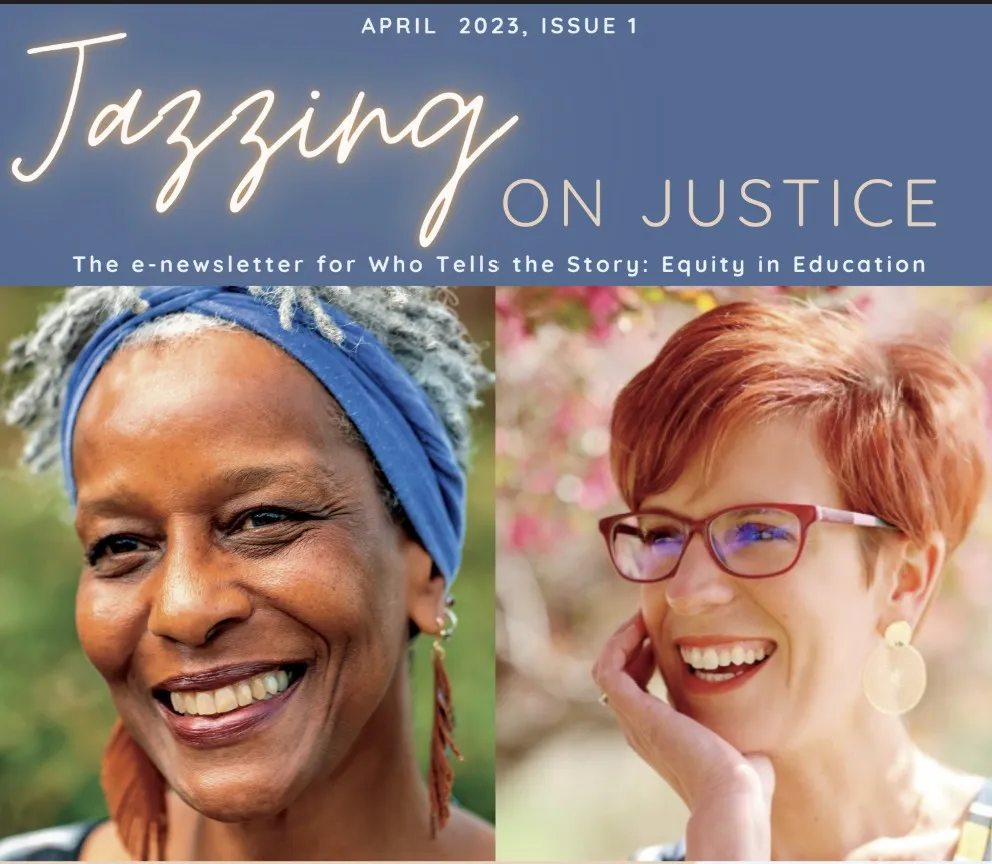
Norma, my partner in Who Tells the Story and a Black racial justice educator and poet, was visiting my classroom for the final time this year. She’d already visited twice before. (To read more about our partnership, click here.) During the visit, she read a poem titled “Like Air.” The poem describes a conversation about childhood experiences between Norma and a White friend of hers. The friend asks Norma, “Did you talk about race with your parents?” Then, in the poem, Norma recounts the many ways race played a role–both painful and joyful–in her upbringing
Students listened attentively to lines like–
Race was in the car with me when my brother drove us to pick up my mom
from the white people’s house she cleaned, where we had to go to the back
door to get her.
And..
Race was in the way we could get loud and raucous and full of fun and
aliveness when we gathered together without white folks around.
Norma ends the poem by coming back to the original question.
And what was it you asked? Did we talk about race…. well, yes…some. But it
didn’t always have a name you know. Mostly it was just there, like air.
Each line in the poem tells a story in and of itself. So the kids were full of follow-up questions, wanting to know the context of each reference. At one point in the poem, Norma discusses how “those flesh colored crayons and BandAids never did look anything like the flesh on my bones.” Having learned from past classroom visits how valuable hands-on experiences are for students (Norma has presented this poem to my class going on three years), she now passes around samples of bandages in a variety of skin tones while explaining how elated she felt when she could cover a wound with something that matched her skin. Kids are riveted–and often come up with many other ways being White (or male or straight or cisgendered or speaking English) is normalized throughout our culture.
Norma and I typically follow up the poem, BandAid presentation, and discussion with a mini-lesson on language. The poem references a variety of racialized words–many of which kids no longer know–words like “Negro” and “Sambo.” And bringing up these words, of course, leads to discussions of the N-Word.
In years past, we’ve talked about the word–but briefly. This year, though, Norma confronted the word more directly. I hadn’t discussed the use of Nazi symbols and gestures among students with her beforehand. But maybe she just felt the community needed a more direct discussion about hate speech.
She started the conversation by saying “I know you know the word. You hear it in music. Maybe you hear your friends say it. I’m only going to say it once.” And then she said the word in front of the students. Hearing the full word out loud made my stomach clench. How would students react? What might parents say? What would the principal think? I took a deep breath to calm my nerves, trusting Norma knew what she was doing.
The student response was a kind of silence I rarely hear in middle school. Norma went on to say, “I’m not going to tell you not to say it, but you ought to understand the word’s history.” She then recounted how the word was often coupled with extreme violence, how it was used to justify horrific acts, how it brings up unimaginable pain for so many. She then ended her explanation saying, “It was often the last word someone heard before they were lynched…or worse.”
Students sat in stunned silence–immobile in body and voice. A thickness in the air made it hard to breathe.
The next day, I brought up the moment with students. Some said they felt uncomfortable hearing the word, others noted the tense feeling in the space, many weren’t yet ready to talk about it. I also told my principal about it in case any parents approached her.
So far, nothing has come about. No students discussed the incident beyond my probing. No parents asked questions. And, as far as I know, no other incidents of racial slurs occurred before the end of the school year.
I don’t know if Norma’s honest, vulnerable, jolting discussion of the N-Word will have an affect on White kids at Southern Hills using the derogatory slur going forward. Like so many moments in teaching, the seeds are planted without any expectation of knowing what exactly the garden might look like. Still, students in my room that day were moved in ways I’d never experienced. While I doubt they’ll all transform into champions of racial justice, speaking out anytime they encounter a hate speech, I can’t imagine the next time they hear–or say–the N-Word, they won’t at least be reminded of Norma’s words and the way they felt when someone finally trusted them to know the truth behind the word they’re never supposed to say.
.jpg)
Educator

.webp)